

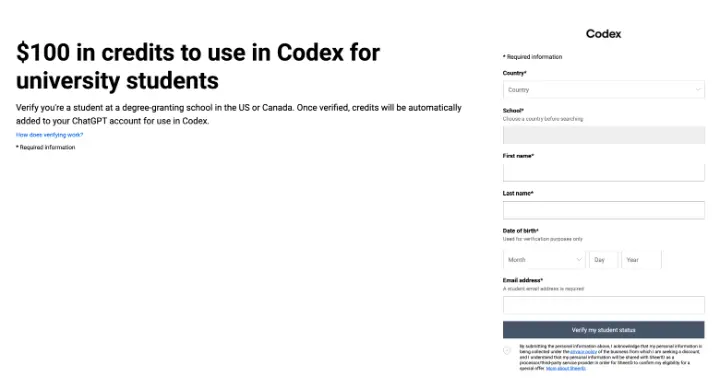
OpenAI is running a free Codex student credit — $100 at no cost for verified university students in the US and Canada. It’s not a subscription tier or a recurring deal. Just a one-time free credit drop once you verify your student status.
Two things to get straight before you apply: first, these credits are specifically for Codex, OpenAI’s AI coding agent — not ChatGPT Plus, not API credits. Second, you need a personal ChatGPT account. If your school set you up with a managed Edu or Enterprise workspace, that won’t work for redemption.
Who Qualifies
US and Canada only, currently. You need to be actively enrolled at a degree-granting university — community colleges and non-degree programs are a grey area the official page doesn’t explicitly address.
You also need to be residing in the US or Canada at the time you claim. Just being enrolled at an American school while living abroad may not be enough.
Gap semester or already graduated? The verification will likely bounce you. Same if you’re between programs. Enrollment needs to be active.
One per student, one time. Can’t claim it again on a second account.
The Verification Process
Verification runs through SheerID, a third-party student identity service. You’ll go through this after signing in at chatgpt.com/codex/students.
Typically it starts with your university email — if SheerID can verify you instantly from your email domain, you’re done in a few minutes. If it can’t, it may ask for documentation like a student ID or enrollment letter. That part varies by school and can take longer.
One thing that caught people: if you’re using a school-issued email tied to a managed Edu or Enterprise ChatGPT account, you might run into trouble. The credits go to your personal workspace. Log in with your personal OpenAI account before starting the flow.
What the Credits Actually Cover
The $100 equals 2,500 Codex credits inside ChatGPT — these are platform credits that extend your Codex usage cap beyond what’s included in your existing plan (Free, Go, Plus, or Pro). They are not OpenAI API credits and won’t show up in API billing.
According to OpenAI’s terms, the credits are intended solely for extending Codex usage within the ChatGPT platform. That means they apply when you’re running Codex tasks through:
- chatgpt.com (the web interface)
- Codex CLI (the command-line tool)
- IDE extensions (VS Code and similar integrations)
They do not apply to API calls, external tool integrations via API keys, or any usage outside the ChatGPT platform.
What You Can Do With It
Codex is an AI coding agent, not a chatbot. It runs code in a sandboxed cloud environment and can handle multi-step tasks autonomously — write, run, debug, and iterate without you supervising every step.
The four main things you can use it for:
Writing and implementing code — Give it a goal like “add login to this API” or “build a data pipeline from these CSVs” and it will plan, write across multiple files, and run it. Not just autocomplete — actual autonomous implementation.
Debugging and fixing — Hand it an error or a failing test. It can read your codebase, trace the issue, patch it, and rerun to confirm the fix.
Explaining and documenting — Ask it to explain legacy code, generate docstrings, or write a README for a project. Useful when you’re dropped into an unfamiliar codebase.
Automating workflows — Shell commands, package installs, build steps, running scripts on datasets. Anything you’d normally do in a terminal, Codex can do in sequence as part of a longer task.
For students specifically:
- Debugging assignments when you’ve been staring at the same error for two hours
- Generating boilerplate so you can focus on the actual logic
- Refactoring messy code before submitting
- Getting through hackathon prototypes faster
- Learning a new language or framework by watching it work through real problems
- Running data analysis scripts without having to write all the pandas from scratch
The free $100 goes a reasonable distance at coursework scale. More demanding tasks — long agents, heavy iteration on a large codebase — will burn through it faster. Worth being deliberate about where you use it.
Is It Worth Claiming for Free?
OpenAI’s own positioning on Codex is that it’s designed for every role, not just engineers. That’s worth keeping in mind when deciding if this applies to you.
CS and software engineering students — obvious call. Codex is in your wheelhouse, the credits will get used, just go claim it.
Research-heavy students (bio, data science, economics, psych) — more useful than you’d expect. Codex can write and run data analysis scripts, automate bioinformatics pipelines, manage LaTeX workflows, and help clean datasets. You don’t need to be a programmer to benefit from that.
Product, business, or design students — also relevant. Codex can help build functional prototypes, generate PRD-style documents, convert design concepts into working UI code, and create dashboards without you writing the underlying code yourself.
Everyone else — harder to say. If your coursework is entirely writing-based with no data, scripts, or tools involved, the credits will probably go unused. But if you’ve ever thought “I wish I could just run a quick analysis on this dataset” or “I want to build something but don’t know how to start,” this is a lower-barrier way to try.
| Who | US & Canada enrolled university students |
| Amount | Free $100 = 2,500 Codex credits |
| Expires | 12 months after grant date |
| Limit | Once per student |
| Verification | SheerID (email + optional docs) |
| Account needed | Personal ChatGPT account (not school Edu/Enterprise) |
| API credits | No — Codex platform only |
Before You Apply
Quick checklist:
- You’re currently enrolled and not on a leave of absence
- You’re in the US or Canada right now
- Your school grants degrees (not just certificates or non-credit programs)
- You have a personal ChatGPT account, separate from any school-managed workspace
- Your school email works and is active
If your school email is already the login for a managed school account, you may need to create a separate personal OpenAI account with your school email as a secondary verification. Worth sorting this out before you start the SheerID flow.
FAQ
Is this the same as the free ChatGPT Plus student offer?
No. OpenAI ran a free ChatGPT Plus promotion for students in 2025 — that ended. What’s available now is $100 in Codex credits specifically, not a free Plus subscription.
What exactly are Codex credits?
The $100 equals 2,500 Codex credits. They extend your usage cap for Codex within ChatGPT. They don’t add to your message limits or give you Plus-level features — just more Codex capacity.
Can I use these credits for the OpenAI API?
No. These are platform credits for Codex inside ChatGPT. They won’t show up in your API billing or work with API keys.
Does my ChatGPT plan matter?
Any plan works — Free, Go, Plus, or Pro. You don’t need to upgrade to claim the student credits.
What if my school uses ChatGPT Edu?
Claim the offer using your personal ChatGPT account, not the school-managed Edu workspace. Credits go to your personal account. If you only have the Edu workspace, you may need to create a personal account first.
Does the credit expire?
Yes, 12 months from the grant date. Don’t let it sit.
Can I claim it on multiple accounts?
No. One per student. Trying to double-claim it will likely get flagged.
Is this available outside the US and Canada?
Not currently. No announced plans to expand.
Bottom Line
It’s a real, free offer. The main things people miss: you need a personal account (not a school Edu workspace), verification goes through SheerID and occasionally asks for documents, and these are Codex credits specifically — not API credits, not ChatGPT Plus. Everything else is pretty straightforward. If you qualify, grab the free $100 and put it to use.